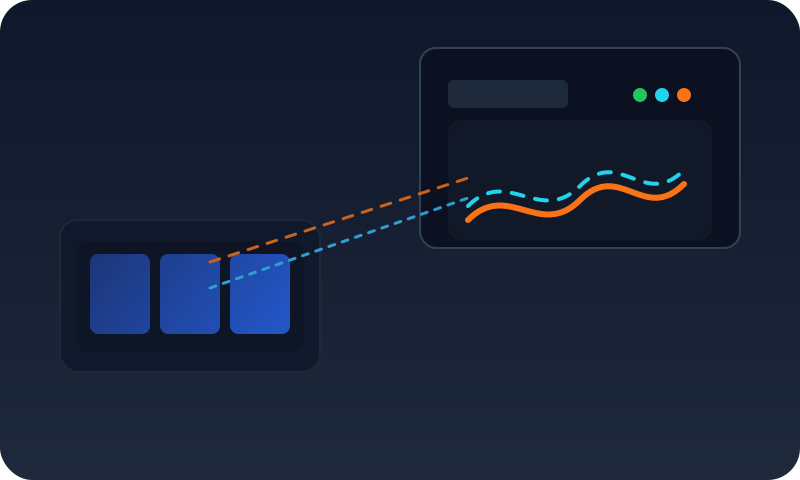
Real-time Visualisation
Dashboards visualise module values in real time, allowing you to adjust your energy consumption intelligently.
Photovoltaik Surveillance & Analytics
Smart energy analytics for your home: monitor, understand and optimise your photovoltaic system with battery storage.
This platform, built specifically for photovoltaics, makes your energy data transparent: monitor performance and efficiency in real time, detect faults instantly, and uncover new opportunities for optimisation and investment.
Capture. Analyse. Optimize. Everything PV owners need to get the most from their solar system.
Dashboards visualise module values in real time, allowing you to adjust your energy consumption intelligently.

Stay informed on the go and detect faults in real time.
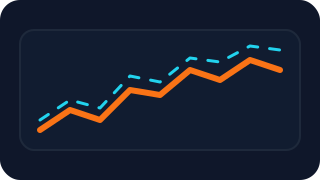
Maximizing the benefits of a photovoltaic (PV) system requires selecting an optimal panel size. Depending on household consumption patterns, PV production characteristics, and financial parameters—including investment costs, electricity selling prices, and panel purchase costs—it is possible to identify the panel size that maximizes overall savings.
The objective is to express total saving potential as a function of PV capacity. The following section describes the energy and cost balances used for this calculation.
The daily PV production and consumption balances (in kWh/day) are:
where is the solar energy that is immediately consumed by the household,
is the solar energy that surpasses consumption and must be sold,
and is the consumption that cannot be met by production of solar energy.
To maintain consistent units, all monetary terms are expressed in €/day, and all energy terms in kWh/day.
Thus, the daily electricity costs become:
Self-consumed PV electricity is assigned the investment-derived cost per kWh produced:
Here:
Electricity exported to the grid yields income at the selling price:
where [€/kWh] is the electricity selling price
Any remaining demand must be covered by grid electricity and is treated as a cost:
where [€/kWh] is the electricity purchase price
The efficiency factor compares the actual daily PV production at the specific location and climate to the theoretical daily production under idealized laboratory conditions (e.g. constant maximal radiation over the whole day):
where
A cloud-native control centre captures telemetry, orchestrates analytics, and delivers insights in real time.
The diagram shows a modern web application architecture for PROD and STAGING. A reverse proxy (Traefik) handles TLS termination and routing. The browser accesses a React/TypeScript SPA via HTTPS, which is delivered as a static application by nginx. API requests (/api/**) are forwarded from the frontend to a Spring Boot backend API, which encapsulates authentication (JWT), business logic, and persistence via JPA on a PostgreSQL database.
Both the production and staging data storage as well as the database shown as a cache are technically based on the same PostgreSQL database instance, which is operated within a single Docker container. These are not separate databases, but rather one shared database that is used differently on a logical level.
The visual separation in the diagram serves exclusively as a matter of emphasis: the data for PROD and STAGING is treated and managed as distinct functional environments, while the caching usage is independent of them. A separate Spring Boot worker executes scheduled jobs, calls the external SEMS API, and writes the results into this shared database.
This architectural decision pursues two goals: first, the SEMS API only allows retrieval of the current values. Since the worker runs as an independent service, no data gaps occur when the rest of the application is updated or restarted. Second, the SEMS API is unstable under a high number of concurrent requests. By centrally collecting and bundling requests, all environments are supplied efficiently while reducing load on the external interface.
View on GitHubPassion for data-driven process automation.

Hi, I'm Markus—a software engineer with a keen interest in digitising business processes. I love translating complex business logic into clean, maintainable, and user-centred software.
I see the interplay between data structure, business logic, and user experience as the key to sustainable digital transformation, and I want to help shape that progress. I combine analytical skills from studying climate physics with the systems thinking of an IT specialist.